
Building Time: Exploring the 6-Bit Digital Circuit Clock DIY Teaching Kit
Products & Deals
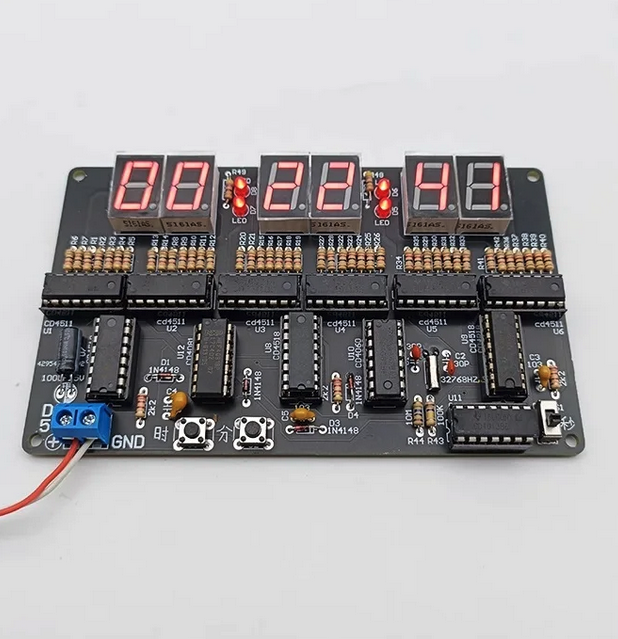
For electronics enthusiasts, students, and educators, there’s nothing quite like the satisfaction of building a functional device from scratch. The 6-Bit Digital Circuit Clock DIY Electronic Clock Teaching Kit from Pacific Custom Engineering offers a hands-on opportunity to dive into the world of digital circuits while creating a working 24-hour clock. Let’s take a closer look at this kit’s features, applications, and what to expect during assembly, making it a valuable tool for learning and experimentation.
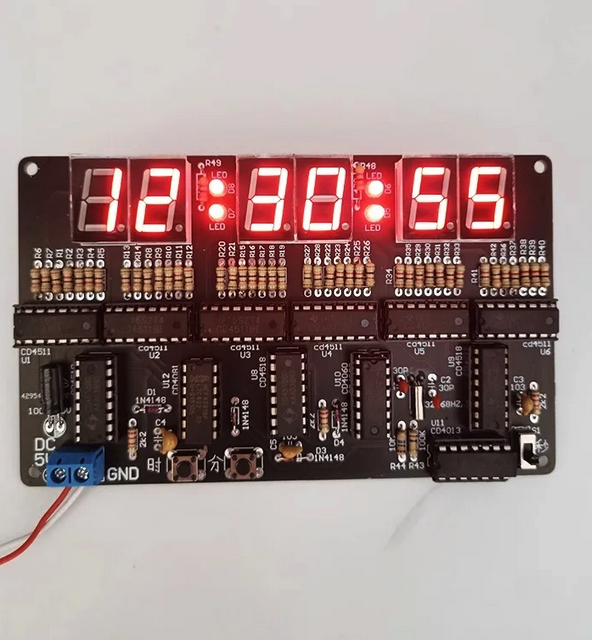
What Is the 6-Bit Digital Circuit Clock Kit?
This DIY kit is a 24-hour digital clock designed as an educational tool, focusing on purely digital circuit design without the use of a microcontroller—meaning no programming is required. The kit leverages a combination of integrated circuits (ICs), including the CD4518 (counter), CD4511 (BCD-to-7-segment decoder), CD4081 (AND gate), CD4013 (flip-flop), and CD4060 (oscillator/divider), to manage timekeeping and display functions. It generates a precise 1Hz square wave signal through frequency division of a high-frequency signal, driven by a 32.768kHz crystal oscillator, achieving an accuracy of ±1 second per 24 hours under ideal conditions.
The clock displays hours, minutes, and seconds on six 0.56-inch red 7-segment BCD (Binary-Coded Decimal) displays, providing a clear, bright readout. It includes calibration buttons for setting the time but lacks an alarm function or time memory, so the time must be reset after power loss. The kit requires assembly and soldering, with components such as a PCB board, resistors (470 ohm, 1K, 2.2K, 100K, 10M), capacitors (103 monolithic, 30P porcelain chip, 25V 100µF), diodes (1N4148), a 6x6x5 keypad, a 12D07 toggle switch, and IC blocks (16P and 14P). Once assembled, the clock measures approximately 100mm x 55mm x 12mm and operates on a 5V DC power supply via a KF301-2P terminal, making it compatible with standard USB power sources.
Key Features and Specifications
- Display: Six 0.56-inch red 7-segment BCD displays for hours, minutes, and seconds in a 24-hour format.
- Accuracy: ±1 second per 24 hours, driven by a 32.768kHz crystal oscillator and 1Hz square wave signal.
- Circuit Design: Uses CD4518, CD4511, CD4081, CD4013, and CD4060 ICs—no microcontroller or programming needed.
- Power Supply: 5V DC via KF301-2P terminal, easily powered by a USB source.
- Dimensions: Approximately 100mm x 55mm x 12mm (assembled), compact for desktop use.
- Assembly: Requires soldering, with over 50 components for hands-on learning.
- Operating Range: Suitable for -20°C to +85°C environments, based on typical component ratings.
Practical Applications
This kit serves as more than just a clock—it’s a gateway to understanding digital electronics:
- Educational Training: Ideal for teaching digital circuit theory, including frequency division, oscillation, and BCD decoding, as students assemble a functional timekeeping device.
- Soldering Practice: With over 50 soldering points, it offers valuable practice for beginners and intermediate learners, enhancing skills in component placement and soldering techniques.
- Electronics Learning: Demonstrates the roles of counters, decoders, and signal generators in a real-world application, making abstract concepts tangible.
- DIY Hobby: Provides enthusiasts with a rewarding project, resulting in a functional 24-hour clock for personal use or display.
- STEM Projects: Perfect for school science fairs or electronics workshops, encouraging students to explore circuit design and timekeeping principles.
Assembly and Considerations
Assembling the 6-Bit Digital Circuit Clock Kit is a rewarding but potentially challenging process. The PCB is labeled to guide component placement, but the kit requires basic soldering skills and attention to detail. Polarity matters—incorrect placement of components like diodes or capacitors can lead to malfunctions.
The claimed accuracy of ±1 second per 24 hours assumes proper assembly and high-quality components, but some users of similar kits report slight time drift—up to 30 seconds per month. Additionally, the lack of time memory means the clock resets after power loss, a limitation to consider for continuous use.
The kit’s reliance on a 5V power supply is convenient, but ensuring a stable power source is key to maintaining accuracy.
Why This Kit Stands Out
What makes this kit particularly appealing is its focus on pure digital circuitry, avoiding the complexity of microcontrollers and programming. This design choice allows learners to focus on fundamental concepts like signal generation and decoding, which are core to understanding how digital clocks—and many other electronic systems—function.
The use of 7-segment BCD displays, driven by the CD4511 decoder, provides a clear visual representation of the circuit’s output, making it an excellent teaching tool. Pacific Custom Engineering’s provision of genuine components ensures reliability, though careful assembly is still critical to success.
Conclusion
The 6-Bit Digital Circuit Clock DIY Electronic Clock Teaching Kit from Pacific Custom Engineering is a valuable resource for anyone looking to deepen their understanding of digital electronics. Whether you’re a student, educator, or hobbyist, this kit offers a practical way to learn about circuit design, soldering, and timekeeping, all while building a functional 24-hour clock. Be prepared for potential assembly challenges and the need for recalibration, but the educational rewards are well worth the effort. You can explore this kit further at /products/6-bit-digital-circuit-clock-diy-electronic-clock-teaching-kit/.